
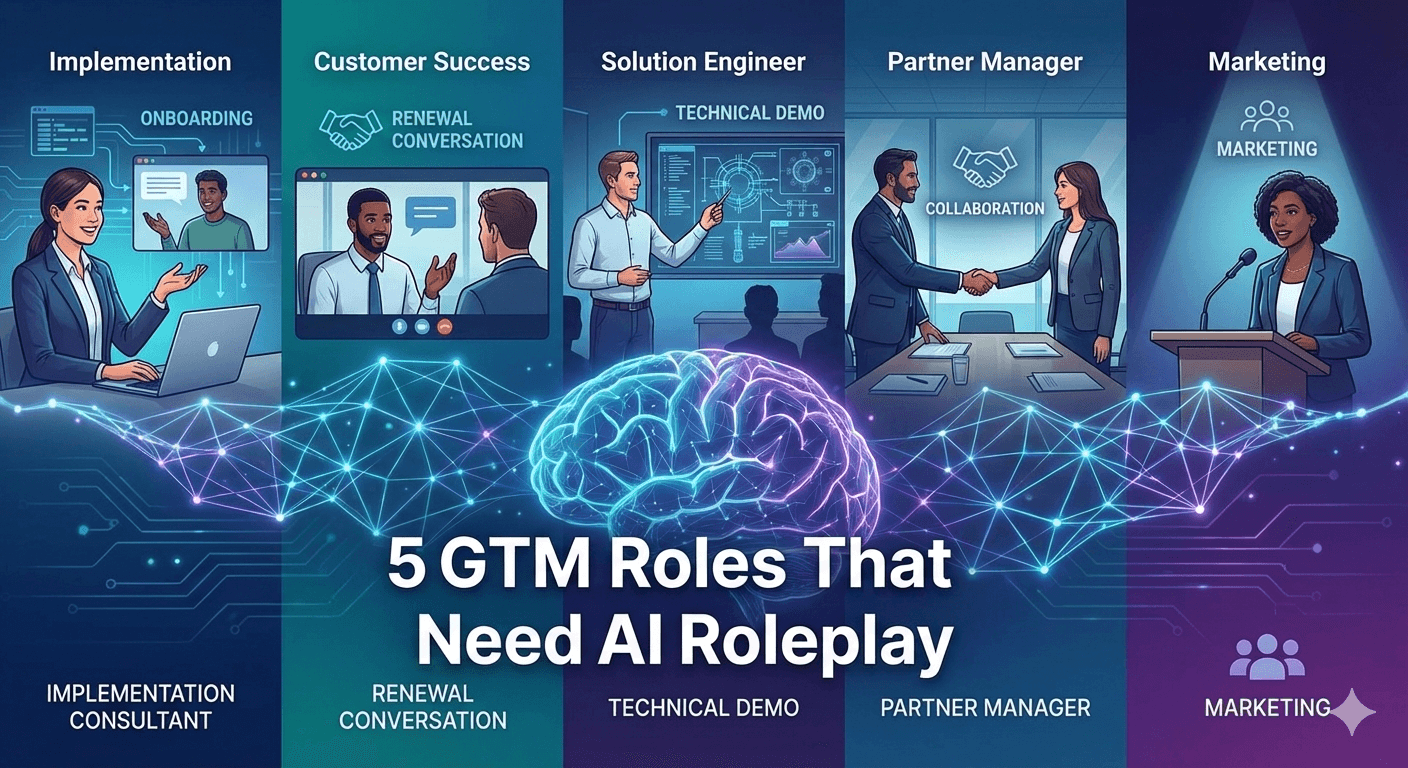
5 GTM Roles That Need AI Roleplay (And You Probably Didn't Think Of)
When most people hear "AI roleplay for business," they immediately think of sales training. Sales reps practicing cold calls, handling objections, closing deals—that's the obvious use case.
But here's what's becoming clear: every revenue-impacting role involves high-stakes conversations that can make or break customer relationships. And most of these professionals get far less training and practice than their sales counterparts.
The solution engineer who fumbles a technical question during a demo. The implementation consultant who mismanages customer expectations. The customer success manager who loses a renewal because they couldn't articulate value. The partner manager who fails to align on a co-selling strategy.
These aren't sales conversations, but they're just as critical to revenue outcomes—and often more consequential because they happen with existing customers who have already invested in you.
AI roleplay technology is expanding beyond the sales floor to transform how every go-to-market team prepares for the moments that matter. Here are five GTM roles that desperately need AI roleplay practice (and probably aren't getting it).
Role 1: Implementation Consultants
The Challenge: Managing Customer Expectations During Onboarding
Implementation teams have one of the hardest jobs in the entire customer journey. They inherit the promises made during the sales process and must deliver results while navigating technical complexity, organizational politics, and often unrealistic expectations.
The statistics are sobering: poor onboarding accounts for 23% of customer churn, and if issues aren't resolved during the first interaction, 67% of customer churn becomes preventable. Yet implementation consultants typically receive technical training on the product, but little preparation for the difficult conversations that determine implementation success.
Key Scenarios Implementation Teams Need to Practice
Scope Management Conversations:
"We thought this feature was included in our package"
"Can't you just add this one extra workflow?"
"Our VP wants to expand the rollout to three more departments"
"The sales team said this would be easy"
Timeline and Resource Discussions:
Delivering news about delays due to technical blockers
Explaining why customer resource availability is impacting progress
Managing unrealistic "go-live" deadline expectations
Negotiating additional discovery time when requirements weren't clear
Technical Limitation Reality Checks:
"The demo showed this working differently"
Explaining integration constraints diplomatically
Discussing workarounds when the ideal solution isn't possible
Managing disappointment when technical debt surfaces
Stakeholder Alignment:
Navigating conflicting priorities between departments
Getting buy-in from unresponsive or skeptical stakeholders
Managing the executive who questions whether this was the right decision
Facilitating difficult conversations between customer teams
Why It Matters: First Impressions Predict Long-Term Success
The implementation experience sets the tone for the entire customer relationship. A smooth onboarding creates customer champions. A rocky implementation creates detractors who will churn at the first opportunity—or worse, become vocal critics.
Implementation consultants need to practice these conversations because they rarely get second chances with real customers. By the time you realize you mismanaged expectations or handled a difficult stakeholder poorly, you've already damaged the relationship.
Personas to Build
The Impatient Executive Sponsor: Expects immediate value, doesn't understand technical complexity, questions the investment
The Scope Creep Champion: Every call surfaces new "critical" requirements that weren't in the original plan
The Technical Blocker: IT security, infrastructure limitations, or integration challenges that threaten timelines
The Ghosting Stakeholder: Agreed to provide resources and input but is now unresponsive, stalling the project
The "This Should Be Easier" Business User: Frustrated by complexity, comparing unfavorably to previous tools
Role 2: Customer Success Managers
The Challenge: Retention Conversations with Customers Who Are Already Unhappy
If sales is about creating relationships, customer success is about maintaining them—often under difficult circumstances. CSMs inherit customers who may have been oversold, underserved, or frustrated by implementation. They're responsible for retention, expansion, and value realization, but the conversations required to achieve those goals are often emotionally charged and high-stakes.
Unlike sales, where you're starting fresh with a prospect, CS conversations carry the weight of history, unmet expectations, and existing relationships. One poorly handled renewal conversation can destroy months of relationship building.
Key Scenarios CSMs Need to Practice
Retention and Renewal Pressure:
"We're not seeing the ROI we expected"
"Your competitor just reached out with a better offer"
"Budget cuts mean we're evaluating all vendors"
"Our champion left the company and the new exec doesn't see the value"
Expansion and Upsell Opportunities:
Identifying and articulating expansion value without seeming pushy
Cross-selling to new stakeholders who don't know you
Moving from department-level to enterprise-wide adoption
Converting a satisfied user into an expansion champion
Crisis and Escalation Management:
Handling calls after service outages or major bugs
Managing executive escalations from frustrated stakeholders
Addressing missed expectations or failed use cases
Rebuilding trust after implementation problems
Strategic Business Reviews:
Presenting QBRs that drive action, not just report metrics
Articulating ROI when the data isn't clear-cut
Discussing roadmap priorities and feature requests diplomatically
Navigating difficult conversations about product gaps
Why It Matters: They Drive Significant Revenue Impact
In SaaS and subscription businesses, customer success drives significant revenue impact. Approximately 40% of SaaS revenue now comes from renewals and expansion, with top-performing companies seeing over 60% of new monthly recurring revenue from expansion. Customer success manages the majority of post-sale revenue, which represents 70-80% of total customer lifetime value. Yet CSMs typically receive a fraction of the training investment that sales teams get.
The cost of an unprepared CSM is immediate and measurable: lost renewals, missed expansion opportunities, and customers who churn to competitors. AI roleplay allows CSMs to practice these high-stakes conversations before they're managing real retention risk.
Personas to Build
The Budget-Conscious CFO: Needs clear ROI justification, comparing you to alternatives, considering cuts
The Frustrated Power User: Has hit product limitations, feeling let down by unmet expectations, considering alternatives
The New Executive Stakeholder: Didn't make the original buying decision, questioning the investment, open to change
The Departing Champion: Your internal advocate is leaving and you need to transfer the relationship
The Escalation Executive: Angry about service issues, demands immediate resolution, threatening to escalate further
Role 3: Solution Engineers
The Challenge: Technical Credibility Under Sales Pressure
Solution engineers operate at the intersection of technical expertise and revenue generation. They're expected to deliver flawless demos, answer complex technical questions on the spot, navigate competitive comparisons, and maintain credibility—all while supporting deals worth hundreds of thousands or millions of dollars.
The pressure is immense: one wrong answer, one failed demo, one mishandled technical objection can kill a deal. Yet most SEs learn through trial and error, practicing their craft on real opportunities with real prospects.
Key Scenarios SEs Need to Practice
Discovery and Technical Qualification:
Asking the right technical questions to uncover real requirements
Identifying integration needs and technical dependencies early
Navigating security and compliance deep-dives
Managing conversations with multiple technical stakeholders with competing priorities
Demo Excellence Under Pressure:
Customizing demos on the fly to address specific use cases
Handling interruptions and challenging "gotcha" questions
Recovering gracefully when something doesn't work as expected
Addressing "But can it do X?" objections mid-demo
Competitive Technical Battles:
Head-to-head technical comparisons with competitors in the room
Addressing competitor FUD without getting defensive
Handling "Your competitor does this better..." challenges
Differentiating on technical capabilities while staying honest about limitations
POC and Technical Validation:
Scoping proof-of-concepts that are achievable and meaningful
Managing technical blockers that emerge during evaluations
Navigating IT security reviews and architecture assessments
Handling technical objections that threaten deal progression
The "Honesty Under Pressure" Scenarios:
"Can your platform do [thing it can't actually do]?"
"Why is your API rate limit lower than competitors?"
"This integration doesn't work the way your sales rep described it"
"We need this feature for go-live but it's not on your roadmap"
Why It Matters: They Make or Break Technical Evaluations
In complex B2B sales, the SE's performance often matters more than the AE's. Buyers can forgive a mediocre sales pitch if the technical evaluation is excellent. They won't forgive a poor technical showing, no matter how good the sales relationship is.
SEs also face a unique challenge: they need to be technically accurate (credibility), business-savvy (value articulation), and sales-oriented (moving deals forward)—a rare combination of skills that requires extensive practice.
Personas to Build
The Skeptical CTO/VP Engineering: Technical depth, looking for gotchas, comparing architectures, testing your knowledge
The Detail-Obsessed IT Manager: Wants answers to every technical specification, focused on edge cases and limitations
The Security/Compliance Officer: Paranoid about risk, needs proof of certifications, asks about encryption and data handling
The Engineer Who Wants to Stump You: Asks increasingly technical questions to test your limits, enjoys finding gaps
The Business Buyer Without Technical Context: Needs you to translate technical capabilities into business value
Role 4: Partner/Channel Managers
The Challenge: Enablement Without Direct Control
Partner and channel managers have a unique and often underappreciated challenge: they're responsible for how external stakeholders represent your brand, but they can't control the conversation.
When a partner misrepresents your product, botches a demo, or loses a deal due to poor positioning, it reflects on you—but you weren't in the room. Partner managers need to enable, align, and influence without authority, often across organizations with competing priorities.
Key Scenarios Partner Managers Need to Practice
Partner Enablement and Training:
Onboarding new partner sales teams on your value proposition
Correcting misconceptions about your product capabilities
Teaching partners to position against competitors
Managing partners who aren't prioritizing your solution
Co-Selling Alignment:
Negotiating deal registration and revenue sharing
Aligning on account strategy and next steps
Managing conflicts when both teams want to lead the relationship
Navigating disagreements about deal qualification or timing
Performance and Accountability Conversations:
Addressing underperforming partners who aren't hitting quotas
Discussing why deals are slipping or stalling
Managing partners who overpromise or misrepresent capabilities
Having difficult conversations about partnership continuation
Strategic Alliance Management:
Executive alignment discussions with partner leadership
Negotiating co-marketing initiatives and joint value propositions
Managing competitive dynamics when partners also work with competitors
Discussing partnership expansion or contraction
Why It Matters: Partners Represent Your Brand
In many B2B companies, partner-sourced revenue now represents 26-28% of total sales in 2025, up from 18-20% in 2024. Mature partnership programs generate 28% of revenue on average, with nearly half of organizations attributing 26% or more of their revenue to partners. Yet partners typically receive far less training and support than your direct sales team. The result? Inconsistent messaging, lost deals, and damaged brand reputation.
Partner managers who can confidently navigate enablement, alignment, and accountability conversations create partnerships that actually drive revenue. Those who avoid difficult conversations or fail to influence partner behavior end up managing relationships that consume resources without delivering results.
Personas to Build
The Under-Trained Partner Rep: Enthusiastic but doesn't understand your positioning, makes mistakes in customer conversations
The Competing Priority Partner: Works with multiple vendors including competitors, doesn't prioritize your deals
The Deal Registration Fighter: Disputes over who owns the relationship and deserves credit for the opportunity
The Strategic Alliance Executive: High-level stakeholder focused on partnership ROI and strategic alignment
The Overpromising Partner: Tells customers "yes" to everything, creates implementation nightmares
Role 5: Marketing (Customer-Facing Roles)
The Challenge: Brand Representation in Unscripted Environments
Marketing is often thought of as a "behind the scenes" function, but many marketing professionals regularly face unscripted, high-stakes conversations that can shape brand perception, influence analyst coverage, or generate viral (good or bad) moments.
A product marketing manager fumbling an analyst briefing. A CMO mishandling a tough question at a conference. A communications lead struggling through a crisis interview. These moments can undo months of careful positioning work in minutes.
Key Scenarios Marketing Needs to Practice
Analyst Relations and Briefings:
Presenting to Gartner, Forrester, or industry analysts who influence buyer perception
Handling skeptical questions about market positioning or capabilities
Navigating competitive comparisons in analyst evaluations
Articulating vision and roadmap without overpromising
Media and Press Interactions:
Reporter interviews on company news or industry trends
Handling unexpected or challenging questions about competitors, pricing, or strategy
Crisis communications during product issues or company controversies
Podcast appearances where you can't control the direction of conversation
Event Speaking and Panel Discussions:
Conference presentations with live Q&A
Panel discussions where you're responding to other speakers
Handling aggressive or off-topic audience questions
Representing your brand alongside competitors on stage
Customer Advisory Board Facilitation:
Running CAB sessions that generate actionable insights
Managing strong customer opinions and competing feedback
Handling criticism of product direction or feature priorities
Facilitating difficult conversations between customers with different needs
Internal Executive Communications:
Explaining campaign performance or marketing ROI to skeptical executives
Defending budget allocations or strategic decisions
Presenting repositioning or rebranding recommendations
Handling pushback on messaging or creative direction
Why It Matters: One Interview Can Define Your Brand
In today's environment, every public-facing marketing conversation is potentially amplified. A clip from a conference, a quote in a trade publication, a podcast soundbite—these moments shape how thousands of potential buyers perceive your company.
Unlike sales conversations that happen in private, marketing conversations often have audiences. The stakes are higher because the reach is broader. Yet marketing professionals rarely get the same level of conversation training as sales teams.
Personas to Build
The Aggressive Journalist: Looking for controversy, asks uncomfortable questions, wants a headline-worthy quote
The Skeptical Industry Analyst: Questions your positioning, compares you unfavorably to competitors, influences buyer perception
The Challenging Conference Attendee: Asks tough questions in front of a large audience, potentially confrontational
The Demanding CAB Member: Strong opinions, frustrated with product direction, influential with other customers
The Financially-Focused Executive: Wants to see marketing ROI, questions channel effectiveness, skeptical of brand investments
How to Implement AI Roleplay Across Your GTM Organization
Start with the Highest-Stakes Conversations
You don't need to roleplay every possible scenario. Begin by identifying the conversations that:
Have the biggest revenue impact (renewals, expansions, technical evaluations)
Cause the most anxiety for team members (executive escalations, crisis management)
Show the most inconsistency in quality (new hires, role transitions)
Happen frequently enough to justify the investment
Build Personas That Reflect Your Reality
The power of AI roleplay is in the customization. Don't settle for generic personas—create AI characters based on:
Actual customer types you encounter regularly: Use real examples (anonymized) from recent conversations
Known difficult stakeholders: That challenging CFO, that skeptical engineer, that demanding executive
Competitive scenarios you need to win: Situations where prospects are comparing you to specific competitors
Cross-functional challenges: Personas that multiple teams encounter (the difficult customer, the budget-conscious buyer)
Create Role-Specific Success Rubrics
What "good" looks like for a CSM is different from what "good" looks like for an SE. Build evaluation rubrics that match each role's success criteria:
Implementation Consultants:
Expectation management clarity
Technical explanation without jargon
Problem-solving approach and creativity
Customer confidence and trust building
Customer Success Managers:
Empathy and active listening
Business value articulation
Objection handling without defensiveness
Relationship preservation under pressure
Solution Engineers:
Technical accuracy and depth
Business value translation
Confidence under challenging questions
Competitive positioning effectiveness
Partner Managers:
Influence without authority
Alignment and collaboration
Accountability framing
Strategic relationship management
Marketing Professionals:
Message clarity and consistency
Poise under pressure
Handling unexpected questions
Brand representation quality
Build Cross-Functional Scenarios
Some personas are relevant across multiple teams. Consider creating shared scenarios where:
CS and Implementation both practice with "the frustrated customer"
SE and Sales practice technical close conversations together
Partner managers and Sales practice co-selling alignment
Marketing and Product practice customer advisory board facilitation
This creates consistency in how your organization handles common challenges and improves cross-functional collaboration.
Integrate into Existing Workflows
AI roleplay shouldn't be a separate "training day" activity. Build it into your rhythms:
Onboarding: New hires must demonstrate competency in core scenarios before customer assignment
Product Launches: Teams practice new messaging and positioning before it reaches customers
Pre-Meeting Prep: Team members can practice before high-stakes meetings (renewals, QBRs, analyst briefings)
Continuous Development: Regular practice becomes part of professional growth, like sales reps doing ongoing call practice
Performance Improvement: When someone struggles with a specific conversation type, roleplay becomes part of the coaching plan
The ROI of GTM-Wide AI Roleplay
When you expand AI roleplay beyond sales to your entire go-to-market organization, the benefits compound:
Consistent Customer Experience Across All Touchpoints
Customers interact with many roles throughout their journey—sales, SE, implementation, CS, support. When all these teams practice and prepare using the same standards, customers experience a consistently excellent interaction quality at every stage.
Faster Ramp for Every Customer-Facing Role
Just as AI roleplay accelerates sales rep ramp time, it shortens the learning curve for SEs, CSMs, implementation consultants, and others. New hires can compress months of learning into weeks, contributing to revenue faster.
Reduced Escalations and Improved Retention
Many escalations happen because of mismanaged expectations, poor communication, or unpreparedness in difficult conversations. Teams that practice these scenarios before they happen in real life handle them better, reducing escalations and improving customer satisfaction.
Better Cross-Functional Collaboration
When teams practice together or use shared personas, they develop better understanding of each other's challenges. SEs understand what implementation teams face. CS teams appreciate the sales conversation complexity. This creates empathy and improves handoffs.
Measurable Performance Improvement
With AI roleplay, you can track performance across your entire GTM organization:
Which teams are prepared for customer conversations?
Where are the skill gaps that need coaching?
How does performance in practice correlate with results in the field?
Which scenarios cause the most difficulty across roles?
This data informs targeted coaching, training investments, and process improvements.
Scalable Excellence
The traditional constraint on conversation training is human availability. Managers can only provide so much coaching. Peer roleplay requires scheduling. AI roleplay removes these constraints, allowing unlimited practice without straining team resources.
The Prepared GTM Organization
Sales gets the headlines, but revenue is a team sport. The implementation consultant who builds customer confidence, the SE who nails the technical evaluation, the CSM who turns a detractor into a champion, the partner manager who enables consistent messaging—these roles are just as critical to revenue outcomes.
For too long, these teams have been under-trained relative to their impact. They've learned through trial and error, practicing on real customers with real consequences. The assumption has been that if someone is technically competent or relationship-oriented, they'll figure out the conversation skills.
But that's not how expertise develops. Top performers in any field practice deliberately, receive feedback, and refine their approach. AI roleplay makes that possible for every revenue-impacting role in your organization.
The question isn't whether your GTM teams need conversation practice. They clearly do—the cost of unprepared teams is visible in lost deals, churn, and damaged relationships.
The question is whether you're ready to give them the tools to practice perfect, so they can perform better when it matters most.